
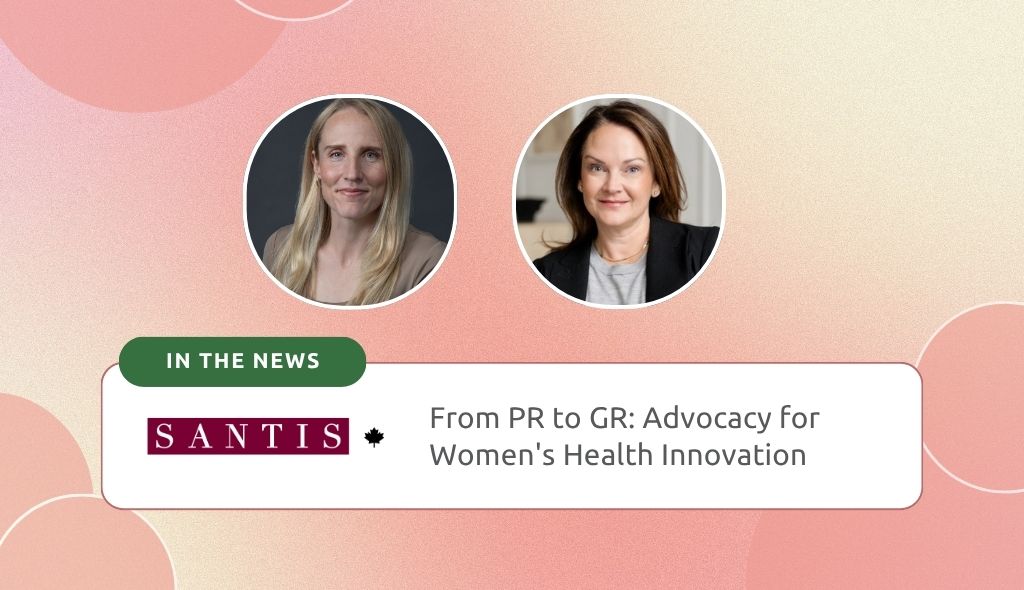
For many early-stage health and life science founders, “advocacy” and “government relations” feel like terms reserved exclusively for multinational corporations with massive policy teams. When you are focused on building a product, securing early investment, and navigating clinical validations, walking the halls of Parliament Hill or your provincial legislature can feel out of reach or like a task to save for much later. But if Femtech founders aren’t in the room, women’s health innovation simply won’t be part of the legislative conversation.
At a recent Femtech Canada roundtable, Nancy Dale, SVP of Communications, and Danielle Flieler, Manager of Federal Government Affairs at Santis Health, explored how founders can use public relations (PR) for government relations (GR) to build influence and create opportunities for femtech companies.
Here is how early-stage ventures can demystify advocacy, use PR to amplify GR, and effectively drive change in Canada’s healthcare landscape.
What Advocacy Really Means
At its core, advocacy is about championing a cause and bridging the gap between rule-makers and those affected by their decisions.
“Advocacy is what puts your issues on the radar for them,” said Danielle Flieler.
For Femtech ventures, engaging early with government stakeholders directly impacts three core areas:
- Regulatory & Reimbursement Pathways: Engaging early allows founders to help shape reimbursement models and procurement guidelines before they are finalized—rather than trying to adapt after rules are finalized.
- Funding & Grant Opportunities: Public sector grants, pilot programs, and strategic investments flow toward organizations that have built visibility and established relationships with decision-makers.
- Long-Term Policy Resilience: When trade policies or local purchasing rules shift, having an established line of communication allows founders to pick up the phone, offer immediate feedback, and protect their business model.
The Two Ways to Use “PR for GR”
PR and GR can be sequenced in two different ways depending on where founders are in the process:
- PR Before GR (Building Credibility): You build public momentum first so that when you ask for a government meeting, officials already know who you are and recognize your brand.
- PR After GR (Applying Pressure): If you have met with government officials but progress has stalled, you use PR to create a public push. Raising public awareness puts pressure on elected leaders to take action.
Make the Message Simple and Personal
One of the biggest challenges for health and life sciences companies is explaining complex problems to people who are not experts in the field.
Nancy shared a simple framework: Connect. Explain. Solve.
- Connect by starting with the human experience behind the problem.
- Explain the issue in simple terms, without technical language or industry jargon.
- Solve by showing how your company offers a practical solution.
The strongest messages combine data with lived experience. A statistic can show the scale of a problem, while a personal story can make that problem easier to understand and remember.
For founders, the advice is to keep the message simple, focus on one or two key points, and make sure there is a clear ask.
Who Do You Talk To?
To maximize impact without wasting valuable time, founders must target the correct level of government based on their current objectives:
- Federal Government (Safety & National Strategy): Focuses on product and device clearances (Health Canada), broad innovation grants, federal procurement frameworks, and overarching health strategy.
- Provincial & Territorial Governments (Healthcare Delivery): Focuses on direct health system integration, hospital procurement, provincial fee codes/reimbursement, digital health integration, and scope-of-practice regulations.
Low-Lift Ways to Start Engaging Today
Advocacy doesn’t require a dedicated team or hundreds of hours. Founders can fit engagement into their schedule using incremental steps:
- 1–2 Minutes: Like, amplify, or share a relevant post on LinkedIn or social media from a peer organization, sector partner, or elected official to stay visible in policy conversations.
- 5–10 Minutes: Follow key government health committees and relevant MPs/MPPs on social media to monitor policy priorities and news cycles.
- 15–30 Minutes: Join collective advocacy efforts, such as co-signing sector letters or supporting campaigns led by organizations like Femtech Canada.
- 1–2 Hours: Request a 30-minute constituency meeting with your local MP or MPP, or participate in organized parliamentary “Hill Days” alongside peer founders.
The Power of a Collective Voice
Advocating as an individual startup can feel daunting, but joining a unified coalition transforms individual challenges into system-wide priorities. When founders, advocates, and ecosystem partners stand together, we ensure that women’s health innovation remains at the forefront of Canada’s economic and healthcare agendas.
Interested in joining the collective voice for women’s health innovation in Canada? Learn more about the National Framework for Women’s Health.